This post may contain affiliate links. Please see our full Disclosure Policy for details.
Scrolling again? Yeah, same. Analog bags have become popular for good reason. They’re simply totes or pouches packed with screen-free activities you grab instead of your phone. Notebooks, puzzles, crafts, books — whatever keeps your hands busy and your mind off that endless doomscroll.
The benefit? It breaks the autopilot habit. When your bag sits where you usually reach for your phone, you have a visible, tangible alternative. No willpower battle. Just an easier choice already in front of you.
The problem? Most guides recycle the same suggestions: journals, knitting, coloring books, crosswords.
But a good analog bag isn’t about looking cute on Instagram. It’s about matching activities to your life — your energy, mood, and time. Because if it doesn’t fit, you won’t reach for it.
That’s what we’re covering here. Practical analog bag ideas that work in real life. No fluff. No pressure. Just screen-free activities you’ll actually want to use.
What Is an Analog Bag and What Should You Put Inside?
At its simplest, an analog bag is just a little collection of non-digital activities you keep handy for when you want a break from your phone. It could be a tote bag, a backpack pocket, a basket beside the couch, or even a small tin tucked in your purse.
So what goes inside? Anything you’d rather do than scroll.
For some people, that means a notebook and a good book. For others, it’s a crochet project, a puzzle book, a sketchbook, a deck of cards, or a tiny embroidery kit. There’s no right or wrong here — just pick things that are easy to grab and actually feel enjoyable.
The real beauty of an analog bag? It takes away that dreaded “What should I do instead?” moment. You’re not relying on willpower. You’ve already decided ahead of time. So when boredom hits — or your hand instinctively reaches for your phone — there’s already something waiting for you.
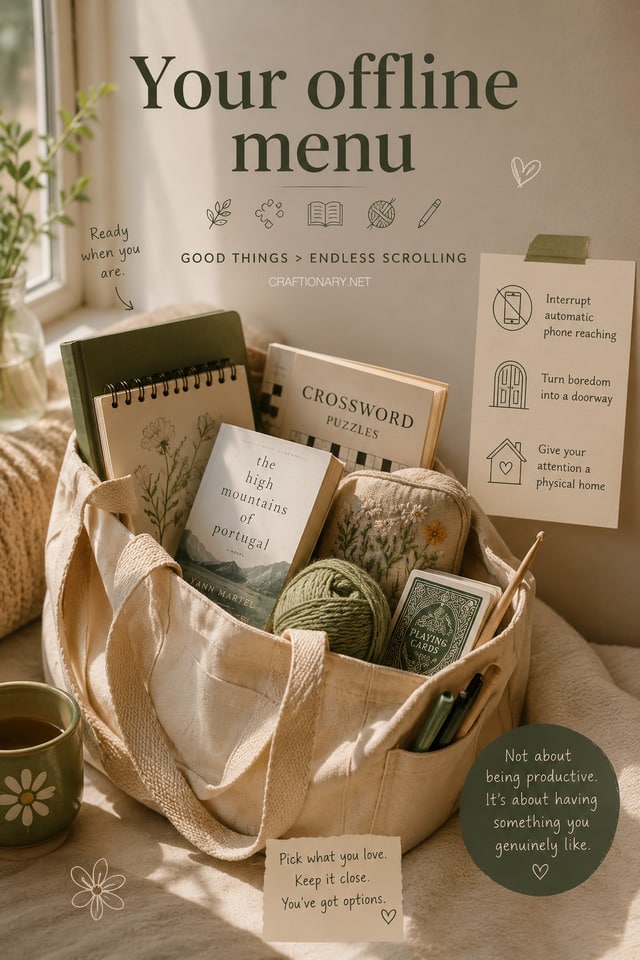
Think of it as a small offline menu filled with things you genuinely like with the purpose to:
- Interrupt automatic phone reaching
- Turn boredom into a doorway
- Give your attention a physical home substituting apps
- It lowers the pressure to be productive by having a replacement habit and not a self-improvement bag
Quick Tip: Pack for Different Amounts of Time
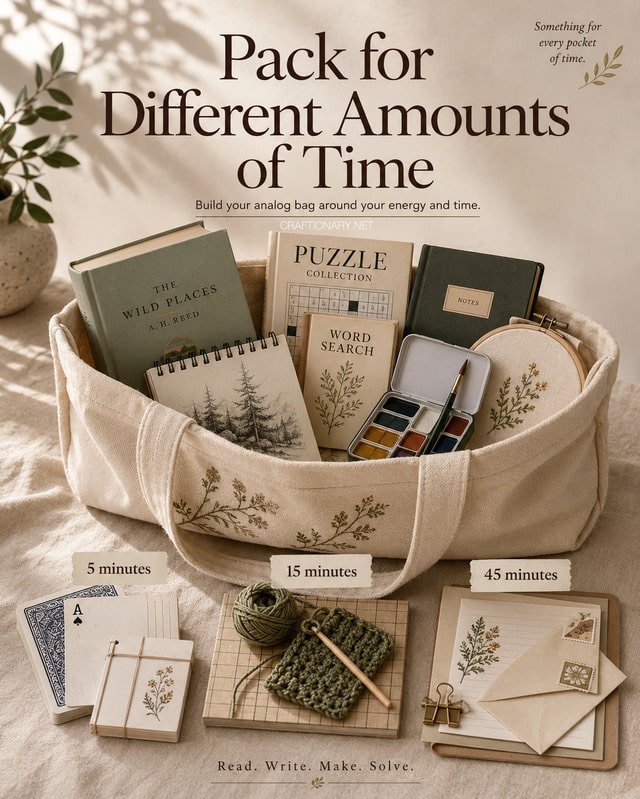
Most analog bags fail because people pack the wrong activity for the wrong energy level. A good bag should include activities for different time windows.
5-Minute Items:
For waiting rooms, car lines, bus rides, quick breaks, or moments of restlessness. Examples:
- Mini notebook for one-line observations
- Pocket word-search or mini crossword
- Index cards with drawing prompts
- A tiny mending task with mending kit
- A single friendship bracelet in progress
- A small tin of paper stars or origami strips
- A “things I noticed today” card
15-Minute Items:
For lunch breaks, cafe time, between classes, or after work. Examples:
- A short essay collection
- A small embroidery hoop
- A travel watercolor set
- A sketchbook
- A zine-making kit
- A deck of cards
- A pocket field guide – birds field guide or wildflowers field guide
- A small crochet motif project
45-Minute Items:
For evenings, screen-free weekends, travel, or intentional hobby time. Examples:
- A longer book
- Knitting or crochet project
- Collage folder
- Letter-writing kit
- Hand-sewing project
- Puzzle book
- Scrapbook pages
- Miniature model or paper craft kit
That way, whether you have a few spare minutes or a quiet afternoon, there’s always something that fits.
So how do you build one:
- Pick a container — tote, pouch, backpack, basket, even a drawer at home
- Add a few things you actually enjoy (not what looks impressive)
- Aim for a good mix — something to read, something to write in, something to make, something to solve
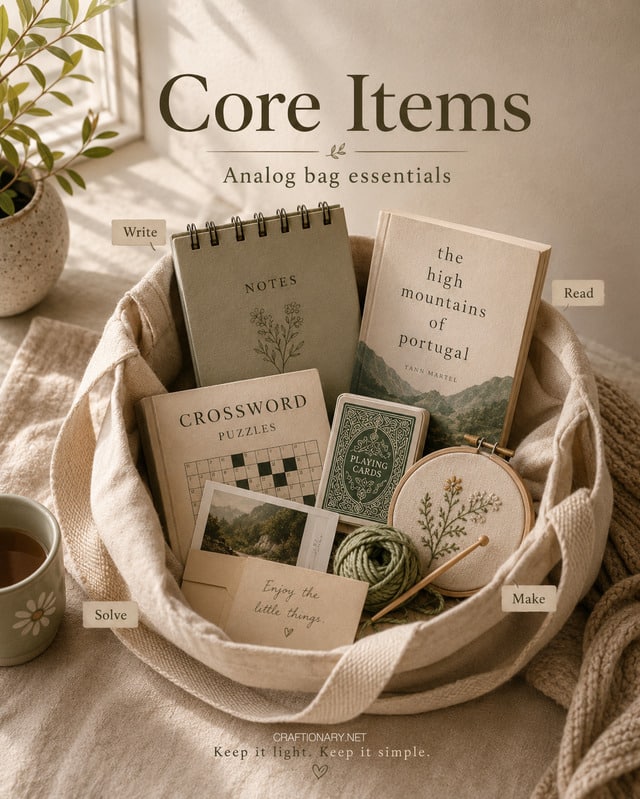
Core Items: Analog Bag Essentials Most People Should Include:
- Notebook or sketchbook: A notebook works better when it has a purpose. A blank notebook can feel intimidating; a labeled notebook or tabs in a notebook invites use.
- Brain-dump notebook
- Commonplace book for quotes and ideas
- Tiny sketchbook
- Field notes notebook
- “Offline search bar” notebook where you write things you would normally Google
- Project notebook for craft ideas
- Gratitude or reflection notebook
- Book you’ll actually open: Avoid vague advise.
- Short stories for stop-and-start reading
- Poetry for small pockets of time
- Essays for thoughtful breaks
- A comfort reread
- A slim classic
- A library book with a deadline
- A pocket-sized nonfiction book
- Puzzle book or deck of cards: Puzzles are useful because they satisfy the same “quick reward” craving that phones often provide, but without the endless scroll.
- Sudoku
- Crossword
- Word search
- Logic puzzles
- Mini chess puzzle book
- Riddle cards
- Tangram puzzle
- Solo card games
- Story dice
- Small craft project: Recommend choosing one, not five. Too many supplies make the bag heavy and mentally cluttered.
- Embroidery
- Crochet
- Knitting
- Macramé cord
- Bracelet making
- Origami
- Paper quilling
- Mini collage
- Sticker journaling
- Visible mending
- Hand lettering
- Something personal (photos, letters, memories)
That’s it. Keep it light. Keep it simple!
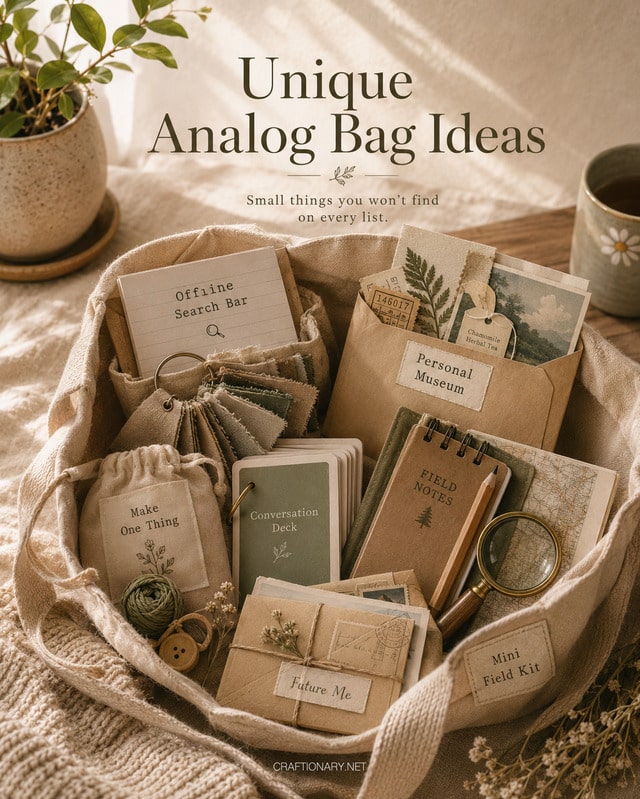
Unique Analog Bag Ideas You Will Not See on Every List
An “Offline Search Bar” Card
This helps stop the reflex of opening the phone for every tiny question. Pack a few index cards labeled:
- Things to look up later
- Questions I had today
- Ideas worth researching
- Random thoughts I almost Googled
A Texture Sampler
Especially useful for crafters and sensory-minded people. Use it for collage, stitching inspiration, color matching, or calming touch. Include:
- Fabric scraps
- Yarn samples
- Ribbon pieces
- Felt
- Lace
- Interesting paper
- Paint swatches
- Thread cards
A Personal Museum Envelope
Pack an envelope for collecting tiny, flat memories. This turns ordinary days into material for journaling, scrapbooking, or memory keeping:
- Receipts from meaningful places
- Ticket stubs
- Pressed leaves
- Tea tags
- Wrappers with nice design
- Notes from friends
- Photo booth strips
- Maps
- Postcards
A Make One Thing Kit
Instead of packing a whole hobby, pack enough to make one finished object. This prevents the bag from becoming a portable craft closet. Examples:
- One bookmark
- One bracelet
- One small stitched patch
- One collage card
- One paper flower
- One greeting card
- One crochet square
- One tiny zine
A Conversation Deck
Pack handmade question cards for friends, family, or solo reflection. Example prompts:
- What is something you miss from childhood?
- What place makes you feel most like yourself?
- What would you make if nobody judged it?
- What skill would you learn if progress was guaranteed?
- This adds a social dimension to the analog bag.
A Mini Field Kit
For people who like nature, cities, or observation. The analog bag can help people notice the world, not just avoid the phone. Include:
- Pocket notebook and Pencil
- Small magnifying glass
- Leaf or cloud guide
- Bird checklist
- Color swatch card
- Small envelope for safe paper items
- Map of your neighborhood
A “Future Me” Packet
This makes the analog bag personal and emotionally meaningful. Include:
- Blank postcards to yourself
- Monthly reflection cards
- A list of tiny goals
- A sealed note to open later
- A “things I’m learning” card
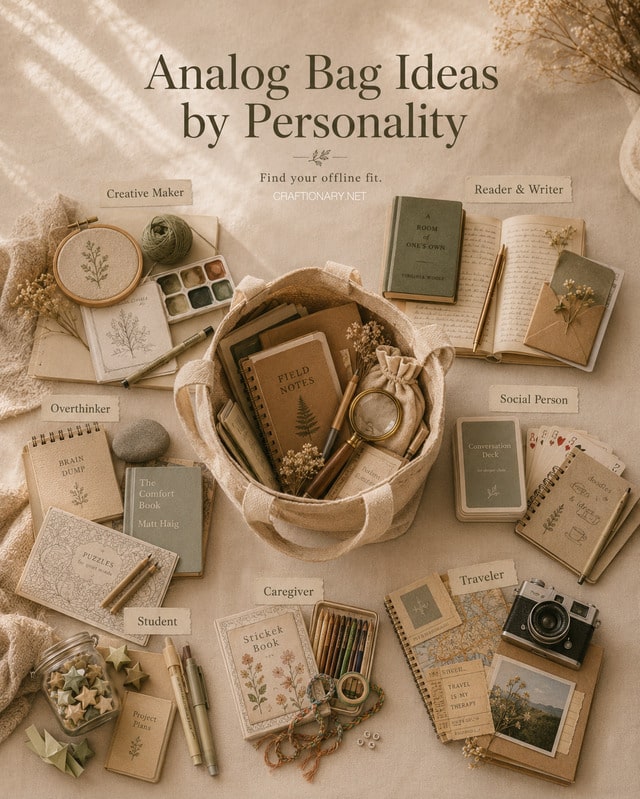
Interesting Analog Bag Ideas By Personality
For the Creative Maker
1. Beginner Crochet Kit
Small projects like socks or dishcloths. Just yarn and a hook. Fits anywhere. Perfect for waiting rooms or commute time.
Shop: Amigurumi animal kit
2. Hand Embroidery or Cross Stitch
A hoop, fabric, needle, and floss in a small pouch. Quiet, focused, and portable. Takes minutes to set up.
Shop: Floral embroidery kit
3. Travel Watercolor Set
A portable set with watercolors and a brush pen. Sketch whatever’s in front of you — a coffee cup, a plant, a face. No mess. No pressure.
Shop: Travel watercolor set
4. Sketchbook + Fine Liners
Doodle prompts like “draw a garbanzo bean.” Takes zero setup. Just open and go.
Shop: mini sketch pad
Shop: Micron fineliner pens
5. Junk Journaling Supplies
Scraps, receipts, ticket stubs, doodles. Huge on TikTok right now. No expectations. Just creative fun.
Shop: Junk Journaling
6. Texture Sampler
Fabric scraps, yarn, ribbon, interesting paper. Great for collage, stitching inspiration, or just a calming touch.
7. Punch Needle Kit
Fast, satisfying, and calming. Most kits include everything you need. Trending right now.
Shop: Highland cow kit
8. Hand Lettering Practice Sheets
Easily carriable sheets with alphabet guides. Practice beautiful writing anywhere. So satisfying.
For the Reader & Writer
9. Short Story or Poetry Collection
Something you can finish in one sitting. Not a 600-page classic you’ll never open.
Shop: Bantum classics
10. Guided Journal
List-making, doodling, reflections. Non-intimidating. Easier than facing a blank page.
Shop: Daily journal guide
11. Letter-Writing Set
Stamps, envelopes, small stationery, address list. Turns idle time into real connection.
Shop: Vintage airmail stationery
12. Future Me Packet
Blank postcards to yourself, self-esteem worksheets, monthly reflection cards, tiny goals, self-notes. Makes your bag feel personal and meaningful.
Shop: Badass Affirmation Cards
13. Mini Commonplace Book
Copy quotes, lyrics, and passages you love. Curates your inner world. Beautiful to look back on.
14. Kindle for the Readers
Technically it’s digital, but many analog bag enthusiasts make an exception for a Kindle. It keeps reading separate from notifications, social media, and endless scrolling, making it easier to enjoy a book anywhere.
Shop: Kindle
For the Overthinker
Keep it supportive and non-medical by including Brain-dump notebook, Worry parking-lot cards, Grounding object, Gratitude list, Slow breathing prompt card, somatic therapy cards and a Comfort book.
15. Pocket Crossword Book
Quiet a busy mind. People love helping with clues in cafes, too.
16. Simple Adult Coloring Book
One basic picture per page. Not detailed or intimidating. Instant calm.
Shop: Large print calm coloring
17. Word Search/Activity Book
Sudoku, Logic Puzzles with calming words, Mazes, etc.Easy to pick up for five minutes.
18. Boredom Menu
A laminated card listing: make something, read one page, draw, write a letter, solve one puzzle, and more.Decision fatigue killer.
Easy Crafts To Do When Bored At Home for Adults
19. Tiny Repair Kit
Needle, thread, safety pins, spare button. Fixing something small feels really satisfying.
Shop: travel sewing kit
For the Social Person
20. Conversation Deck
Conversation card decks with questions to encourage compassion, shift perspective, and social connections. Great for friends or solo reflection.
Shop: Icebreaker deck
21. Deck of Cards
Monopoly Deal, regular playing cards. Rounds take 15 minutes. Need only two players.
Shop: Monopoly deal
22. Reverse Coloring Book
The book has the colors, just draw the lines, then mail it to friends.
Shop: Reverse coloring book
23. Shared Doodle Notebook
Pass it around. Everyone adds something. Fun group activity.
How to Start Doodle-a-Day Journaling: 30 Easy Doodling Ideas
24. Mini Party Game Cards
Portable games are great for cafes or waiting rooms.
Shop: would you rather
For the Student
25. Origami Stars Kit
Strips for folding tiny stars. Quiet, satisfying, takes zero space.
Shop: Origami kit
26. Small Project Notebook
For planning, brainstorming, or sketching ideas.
For the Parent or Caregiver
27. Sticker Books+ Mini Coloring Set
Kid-friendly. Keeps little hands busy too.
Shop: Sticker Scene Book
Shop: Relaxation Coloring Book
28. Scavenger Hunt Book
Simple brain challenge games. Quick brain break during naptime.
Shop: Brain Games
29. Friendship Bracelet Kit
Small, tangle-free. Make them with or without kids.
Shop: Bracelet Designs
For the Traveler or Commuter
30. Film Camera
Makes each shot meaningful. The waiting to see results is the point.
Shop: Half frame camera
31. Travel Scrapbooking Kit
Save tickets, receipts, maps, and tiny memories as you travel, then turn them into a scrapbook later.
Shop: World Travel Scrapbook
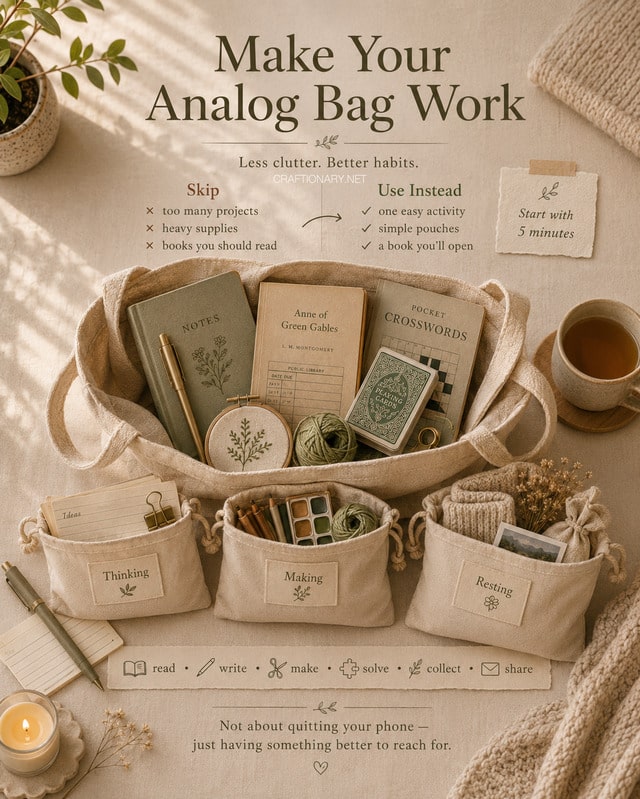
What to Avoid and What to Use Instead?
Skip:
- Too many unfinished projects
- Supplies that spill easily
- Expensive tools you’re afraid to use
- Books you feel you should read
- Activities that need lots of setup
- Loose items without a pouch
- Anything that makes the bag too heavy
Use Instead:
- Half-filled notebooks and Old stationery
- A library book with a dealine
- Simple materials with a craft idea in mind like fabric scraps or leftover embroidery floss
- Paper quilling or sticker journaling
- Puzzle books you already own
- Gift bags, tins, and spare pouches
Organizing Your Analog Bag
A simple way to stay organized is the 3-Pouch System. This setup makes it easy to swap activities in and out without rebuilding your entire bag every time:
1. Thinking Pouch
- Notebook
- Pen
- Index cards
- Planner
- Reflection prompts
2. Making Pouch
- Craft project
- Yarn or thread
- Paper supplies
- Glue/tape
- Scissors
- Small tools
3. Resting Pouch
- Book
- Puzzle book
- Magazine
- Coloring supplies
- Comfort item
How to Actually Use Your Analog Bag Instead of Your Phone
Instead of simply removing the phone, the bag gives your hands and attention a ready alternative. Include practical habit advice:
- Keep it where you usually scroll
- Put your phone in another room for short periods
- Start with five minutes
- Rotate items weekly
- Make the first activity very easy
- Leave projects slightly started so there is less resistance
- Use a visible basket at home
- Carry only one or two activities outside the house
- Do not turn it into a productivity challenge
A Simple Analog Bag Checklist
Create a scannable checklist. If you have these categories covered, your bag will feel more balanced than a random pile of supplies:
- One thing to read
- One thing to write in
- One thing to make
- One thing to solve
- One thing to collect
- One thing to share
- One thing for low-energy days
- One small pouch for tools
- One boredom menu
- One item that feels personal
Frequently Asked Questions
What is an analog bag for?
It’s just a simple way to replace scrolling with something you actually enjoy doing offline.
What should you put in it first?
Start small—maybe a notebook, a book you like, and one easy activity like a puzzle or craft.
Do you need to buy new things?
No. Most of it can come from things you already have at home.
Is it only for creative people?
Not at all. It can be reading, puzzles, writing, collecting, or even just simple quiet activities.
How often should you change it?
Whenever it starts feeling boring or unused. There’s no fixed schedule.
An analog bag isn’t about quitting your phone. It’s about having something better to reach for in those small, quiet moments.
A notebook, a book you like, and one simple activity are enough to start. It doesn’t need to be perfect or aesthetic. It just needs to be yours.
Over time, it slowly becomes the thing you reach for without thinking.
So start today. Grab a bag. Add a few things you love. And see what happens when you reach for something real instead of that glowing rectangle.
Drafted by: Sabah Waqas
Written by: Hani Shabbir
You will also like:
Art Journaling Ideas, Prompts and Guide to Art-a-Day Journal
Slow Stitching: A Guide to Mindful Hand Sewing with Creative Ideas