This post may contain affiliate links. Please see our full Disclosure Policy for details.
Learn to make simple dragonflies and fireflies using maple seed helicopter, twig, and nail polish for fun.
Whether you call them helicopters, dragonflies, fireflies, whirlybirds, or spinning jennies, the mesmerizing descent of a maple seed is one of nature’s most brilliant engineering feats. But there is much more to these winged keys than childhood play.
This guide explores the biology, physics, and ecological importance of the maple samara, answering the most common questions about how they fly and why they matter.
What is a Maple Seed Helicopter?
In the botanical world, the technical term for a maple seed is a samara. A samara is a winged achene—a dry fruit that does not split open to release the seed. Instead, the entire structure acts as a flight vehicle.
Key Characteristics of Maple Samaras:
- The Nutlet: The heavy, rounded part containing the actual seed.
- The Wing: A fibrous, papery membrane that extends from the seed.
- The Pair: Maples typically grow seeds in pairs (forming a V or horizontal line), though they often break apart as they fall.
How to Make Maple Seed Helicopter Dragonfly from Maple Pods?
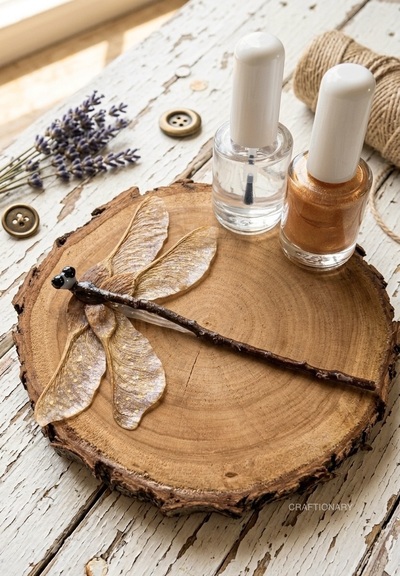
You can use naturally items to make this adorable craft.
Materials
- Maple seed helicopters
- Nail polish
- Hot glue
- Twigs
Instructions:
Collect some maple tree helicopters and twigs to make your own dragonfly. Use the gold nail polish on the wings and bronze on the twig. You may use transparent nail polish with glitter for shine. Glue on two little black beads for the eyes and you are done.
I brushed a bit of iridescent nail polish onto my dragonflies, and it did more than just brighten them up—it made them stronger too. It’s surprising how such a small touch can turn these delicate maple seed helicopters into something much more durable. Now I’m excited to experiment with them in new ways, whether that’s hanging them as Christmas ornaments or letting them sway in a mobile.
The Physics of Flight: How Do They Spin?
Unlike a true helicopter, which uses an engine to turn its blades, a maple seed uses auto rotation. This means it uses the force of the air it’s falling through to generate its own spin.
The Leading Edge Vortex (LEV):
Research from universities like Cornell and Caltech has revealed that maple seeds are aerodynamic masters. As the seed falls:
- Gravity pulls the heavy nutlet down first.
- Air Resistance (drag) pushes against the flat wing.
- The Vortex: The air flowing over the curved leading edge of the wing creates a tiny tornado-like swirl called a Leading Edge Vortex.
This vortex lowers air pressure above the wing, creating lift. This lift opposes gravity, slowing the seed’s descent to a crawl—sometimes just one meter per second—giving the wind more time to carry it away.
Why Do They Spin? (The Evolutionary Purpose)
The goal of every tree is to get its offspring as far away from the mother tree as possible to avoid competition for sunlight and water. This is called anemochory (wind dispersal).
- Distance: By spinning and falling slowly, a maple seed can travel hundreds of yards in a stiff breeze.
- Rain Resistance: A 2025 study found that the spinning motion actually helps the seeds shrug off raindrops, allowing them to disperse effectively even during spring storms.
Frequently Asked Questions
1. When do maple seeds fall?
Most maple trees drop their seeds in late spring and early summer (Silver and Red Maples), while others, like the Sugar and Norway Maples, drop theirs in autumn.
2. Are all helicopter seeds from maple trees?
No. While maples are the most famous, trees like Ash, Elm, and Sycamore also produce samaras. However, Ash seeds have a single straight wing, and Sycamore seeds have a more symmetrical V shape compared to the offset wing of the Maple.
3. Are maple seeds edible?
Yes! If you peel away the outer papery wing, the tiny green seed inside is edible and tastes somewhat like a pea. They can be eaten raw or roasted (though they get bitter as they dry out).
4. How can you tell different maple seeds apart?
The angle between the two joined seeds is a major giveaway:
- Sugar Maple: Forms a U-shape.
- Norway Maple: Forms an almost straight horizontal line.
- Red Maple: Forms a narrow, sharp V-shape.
The maple seed helicopter is a perfect example of biomimicry—human engineers have actually studied these seeds to design more efficient micro-drones and parachutes. Next time you see a helicopter spinning to the ground, remember you’re watching a sophisticated piece of biological technology in action.
Have you noticed the V shape of the seeds in your yard this year? Identifying your tree is as easy as looking at the angle of its helicopters!
You will also like:
62 Nature inspired outdoor projects
30 FUN Kids Gardening Activities with FREE GARDEN PLANNER
50 DIY bug hotels | material and instructions to attract bugs