This post may contain affiliate links. Please see our full Disclosure Policy for details.
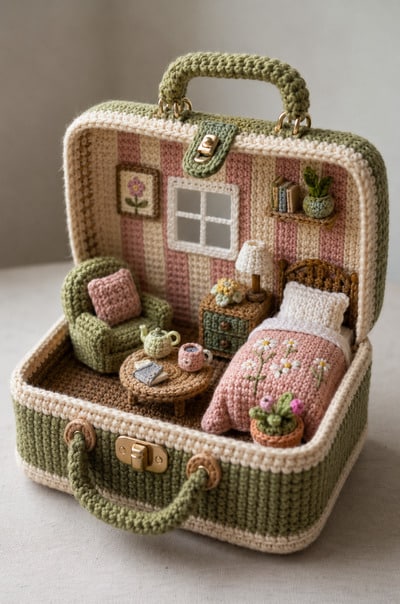
This crochet dollhouse free pattern is inspired by the beautiful vintage suitcase-style crochet dollhouse. This cozy miniature bedroom inside a suitcase features a crochet-covered case, a bed with blankets, furniture, decorative details, and a crochet doll.

Vintage suitcase dollhouse
Inspired by this beautiful vintage suitcase dollhouse, I imagined what a crochet DIY dollhouse in a box, container or even an old repurposed luggage bag look like! Learning how to make a crochet dollhouse is a fantastic way to craft a unique, handmade toy or display piece. Whether you’re making one for a child, as a collector’s item, or as a personalized gift, this guide will walk you through the process of creating a beautiful crochet dollhouse from scratch.
Why Make a Crochet Dollhouse?
- Handmade and Customizable: A crochet dollhouse is completely customizable-you can choose the colors, patterns, and furniture to match your vision.
- A Unique Gift or Heirloom: Handmade crochet projects make great gifts that can be treasured for years, passed down as a special keepsake.
- A Fun and Relaxing Craft: Crocheting is known for being a stress-relieving hobby, and making a crochet dollhouse allows you to enjoy both creativity and relaxation.
1. The Crochet Dollhouse Suitcase:
A Full Amigurumi Bedroom You Can Carry Anywhere
There’s a special kind of magic in a project that opens up to reveal a whole tiny world inside — and that’s exactly what this pattern delivers. On the outside, it’s a sturdy, striped crochet suitcase with a working handle and clasp. Open it up, and you’ll find a fully furnished bedroom: a bed with a folded quilt, a cushioned armchair, a bedside table, a dresser topped with little potted succulents, and a matching chair, all scaled to sit perfectly inside the case.
I’ll be upfront with you, crafter to crafter: this is an advanced, multi-day project. It combines suitcase/bag construction, hinge and hardware attachment, and several small amigurumi furniture pieces, each with its own shaping. If you’ve made a few amigurumi animals and maybe one basic crochet bag, you have the skills to do this — you’ll just want to budget a few evenings rather than a single afternoon. I’ve broken it into completely separate components so you can knock them out one at a time and assemble at the end.

Free Pattern Crochet Dollhouse
Materials:
1. Yarn:
Cotton amigurumi-weight yarn (such as a #3 DK-weight cotton) in:
- Terracotta/rust (main suitcase color + handle)
- Dusty blue
- Sage green
- Mauve/dusty pink
- Cream or oatmeal (interior walls, bedding)
- Small amounts of yellow, purple, and brown for furniture and accent details
2. Hooks:
2.5mm and 3mm steel/small hooks (smaller hook than the yarn label suggests is standard practice in amigurumi — it keeps your stitches tight enough that stuffing doesn’t peek through)
3. Notions:
- Polyester fiberfill stuffing
- A small metal purse clasp/twist lock (available from craft or bag-hardware suppliers)
- Two small hinges or heavy-duty snaps to join the suitcase halves
- Plastic canvas or thin cardboard/craft foam, cut to size, for structural inserts in the base and lid
- Stitch markers
- Yarn needle
- Small amount of florist wire (optional, for chair/table legs if you want extra rigidity)
- Safety eyes or small beads (optional, for any decorative details)
- Gauge: Gauge isn’t critical for this project the way it is for garments, but working tightly (roughly 6–7 sc per inch with your smaller hook) will give you the firm, sculptural fabric this piece needs to hold its shape without floppiness.
Abbreviations
- ch – chain
- sc – single crochet
- hdc – half double crochet
- dc – double crochet
- sl st – slip stitch
- inc – increase (2 sc in same stitch)
- dec – decrease (invisible decrease preferred)
- FLO / BLO – front loop only / back loop only
- st(s) – stitch(es)
- rnd – round
- [ ] – repeat instructions inside brackets the stated number of times
- (x sts) – total stitch count at end of round
Part One: The Suitcase Shell
The suitcase is built as two matching rectangular boxes (a base and a lid), each with a flat bottom, four short walls, and a sturdy rim, worked in single crochet with color-blocked stripes for that layered, ribbon-like look.
Base and Lid (make 2 — identical, one becomes the base, one becomes the lid)
Bottom panel
- With terracotta, ch 16, sc in 2nd ch from hook and each ch across, 3 sc in last ch, continue along opposite side of foundation ch, 3 sc in last ch to close the oval. (32 sts)
- Rnd 2: inc in each of the 3 sts at each rounded end, sc across straight sides. (38 sts)
- Rnds 3–5: sc evenly, increasing 4–6 sts per round only at the curves so the panel lies flat (it should look like a smooth, flat oval/rounded-rectangle, roughly 4.5″ x 3.5″ when done).
- Fasten off. This is your structural floor — cut a matching piece of plastic canvas or craft foam and set aside; it will be slipped inside once the walls are added, for a firm, flat base that won’t sag under the furniture’s weight.
Side walls (worked directly into the bottom panel, no turning)
- Rejoin yarn in any st of the last rnd of the bottom panel. Working through both loops, sc around without increasing for 6–8 rounds to form the wall — this is where you introduce your color stripes. A pleasing rhythm to match the photo: 2 rnds terracotta, 1 rnd dusty blue, 1 rnd sage, 1 rnd mauve, 1 rnd dusty blue, 2 rnds terracotta.
- On the final rnd, sc in BLO only — this creates a small lip that helps the rim sit crisply.
Rim - With terracotta, work 2 rounds of sc, then 1 round of hdc for a slightly raised, rounded edge. Fasten off, leaving a long tail for seaming later.
- Repeat this entire sequence a second time for the matching half. One half will house the furnished room (this is your base); the other becomes the lid.
Joining the Two Halves
- With the base and lid rims facing each other, whip-stitch or crochet a hinge seam along one long edge, joining roughly the back third of the rim on each half together. This becomes your working hinge line.
- If you’d like extra durability (recommended, since this piece will be opened and closed repeatedly), reinforce the crocheted hinge from the inside with two small fabric or felt hinge tabs, hand-stitched invisibly along the seam.
Handle
- With terracotta, ch 4, join to form a ring. Sc around the ring for approximately 5–6″, working in a spiral to create a firm, ropelike tube — you’re essentially making i-cord-style crochet tube. Stuff lightly as you go, or work over a length of pipe cleaner/floral wire for structure and shape-holding.
- Fasten off, leaving long tails at both ends. Attach the two ends to the center-top of the lid’s rim, spaced about 2″ apart, stitching securely through several layers for strength — this handle will bear the weight of the whole piece.
Closures - Attach two short crochet tab loops (ch 8, sc back across, 4–5 sts wide) to the base’s front rim on either side.
- Sew the metal purse clasp/twist lock centered on the lid’s front rim, and a matching tab or eyelet on the base so the two pieces meet and lock when closed, just like the silver hardware .
- Optional: add small strap loops and short handle straps in terracotta at each side of the case with tiny buckle-look details in silver-grey yarn or actual mini findings, echoing the decorative straps visible on the closed suitcase.
Part Two: The Bedroom Interior
Once your base half is complete, this becomes the room. The interior walls are already the cream/oatmeal rounds from your stripe sequence if you swap those in at the top rounds of the base’s side walls — otherwise, felt or crochet a thin cream panel and stitch it in place as a backdrop, then add:
- Window (optional but lovely): Crochet a small cream square frame in hdc, cross two thin strips of yarn or thread inside for windowpanes, and stitch to the back interior wall.
- Floor: worked from the bottom panel itself, or optionally overlaid with a small crocheted rug in a contrast color.
Part Three: The Furniture
Each piece below is worked separately in the round using standard amigurumi shaping, then stuffed and seamed together. All pieces use 2.5mm hook with cream, mauve, sage, or terracotta as noted, worked in continuous spiral rounds (no joining unless stated) with a stitch marker to track the round.
1. The Bed
Mattress base
- With cream, ch 12, sc around foundation ch as in the suitcase base method (see Part One, step 1) to form a small oval. (24 sts)
- Rnd 2: inc evenly. (30 sts)
- Rnds 3–6: sc even, no increases — building the depth of the mattress.
- Stuff firmly and flat as you close.
- Fasten off.
Headboard
- With cream or dusty blue, ch 10, work back and forth in hdc rows for 8 rows to create a small rectangular panel slightly wider than the mattress.
- Fasten off and whip-stitch the headboard to the back edge of the mattress, standing upright.
Bed frame legs
- With cream, make 4 small tubes (ch 3, sc around in spiral for 4 rounds) and stitch one under each corner of the mattress.
Bedding
- Cream or white blanket: ch 14, dc across for 6 rows, fold into thirds and drape over the foot of the mattress as the folded quilt seen .
- Two tiny pillow shapes: ch 4, sc a small flat rectangle 4 rows tall, seam around 3 sides, stuff lightly, close, place at the headboard.
2. The Armchair
- Seat cushion: With mauve, ch 8, work in the round (per Part One step 1 method) for a small oval, inc once, then work 3 rounds even and stuff into a firm cushion disc. Fasten off.
- Backrest: With mauve, ch 9, hdc back and forth for 6 rows to form a rectangle. Fold slightly to curve, stuff lightly between two layers if you’d like a plumper look, and stitch to the back of the seat cushion, standing upright.
- Arms (make 2): With mauve, ch 5, sc in the round for 3 rounds to form a small stuffed roll. Stitch one to each side of the seat/backrest join so the arm sits slightly above the seat height.
- Legs (make 4): With cream, ch 3, sc a short tube 3 rounds tall. Attach under the four corners of the seat.
3. The Bedside Table and Dresser
- Both are worked the same way, simply at two different heights/widths — the bedside table is a small single cube, the dresser a taller, wider version.
- Top panel: With cream, ch 6 (table) or ch 9 (dresser), sc in the round per Part One step 1 to form a small flat rectangle/oval.
- Sides: Working directly from the last round of the top panel, sc around without increasing for 4 rounds (table) or 7–8 rounds (dresser), to form the box body. You may add a contrast-color round (mauve or dusty blue) partway down to mimic little drawer fronts.
- Stuff lightly for structure, or better yet, insert a small cut piece of craft foam or thin cardboard box shape inside before closing the bottom, so the furniture holds a true right-angled silhouette rather than looking soft and round.
- Drawer details: With a contrasting scrap, embroider 1–2 small horizontal lines across the front and add a tiny French knot or seed bead “handle” per drawer line.
- Legs (make 4 per piece): With cream, short 2–3 round tubes, attached under each corner.
Tiny potted plants for the dresser top: With sage or green, make a small pom-pom or cluster of 4–5 short chained leaves fastened into a tuft; stitch to the top of a tiny terracotta crocheted pot (ch 4, sc 3 rounds, cinch closed at the base). Attach 2–3 of these to the dresser top as the little succulents seen .
4. The Round Table and Chair
Table
- With cream, work a small flat circle (6 sc into a ring, inc every round for 2 rounds) for the tabletop, then work 3 rounds even down the sides.
- Attach 3–4 slim crocheted or wire-reinforced legs, splayed slightly outward for stability, just like a small bistro table.
Chair
- Work a small seat exactly as the armchair’s seat cushion, but slightly smaller and un-upholstered — plain cream or dusty blue.
- Add a simple curved backrest (a rectangle of hdc rows, gently curved and stitched to the back of the seat).
- Attach 4 slim legs as with the table.
Assembly
Once every piece is complete:
- Position the bed against the back-left interior wall and stitch or glue the leg bases lightly to the floor panel to keep it from shifting when the case is carried.
- Place the dresser along the back-right wall, bedside table beside the bed’s headboard.
- Set the armchair in the front-left corner and the round table with its chair in the front-right, angled slightly inward as , so the whole room reads as a cohesive little vignette when the case is opened.
- Secure each piece with a few discreet stitches through the floor panel — this keeps the furniture from tumbling around during transport, which is the single most common frustration with this type of project.
Have you made a piece like this before, or is this your first furnished amigurumi build? I’d love to see how your color choices turn out — every stripe combination gives the suitcase a completely different personality.
2. The Cottage-in-a-Suitcase:
A Complete Crochet Dollhouse Pattern
There’s something irresistible about a world that folds shut. This pattern builds a full cottage bedroom — striped wallpaper, a paned window, a floral-embroidered bed, a wingback armchair, a tea table, a little dresser with a lamp, a book-and-plant shelf, framed wall art, and two potted flowers — all tucked inside a crocheted travel case with a working clasp and carry handles.
It’s a big project. Treat it like a series of small ones: build the suitcase shell first, then work through the furniture pieces in any order you like, then assemble. Nothing here is technically difficult on its own — mostly single crochet worked in the round, basic amigurumi shaping, and a bit of surface embroidery — but there are many pieces, so patience and consistent tension matter more than advanced stitch skill.
Skill Level:
Intermediate, with detailed guidance throughout. You should be comfortable with:
- Magic ring, single crochet (sc), increases/decreases (inc/dec)
- Working in continuous rounds (no join, use a stitch marker)
- Basic surface embroidery (straight stitch, French knots, lazy daisy)
- Simple shaping over wire or cardstock for structural pieces (suitcase panels, shelf)
Materials
1. Yarn
Worsted/DK weight, cotton-blend recommended for stitch definition:
- Sage/olive green (suitcase exterior, chair)
- Cream/ivory (suitcase trim, wallpaper stripes, bedding, lamp)
- Dusty rose/pink (wallpaper stripes, bedding, chair pillow, flowers)
- Tan/camel (suitcase interior lining, table, shelf, teapot base)
- Brown (bed frame, dresser, shelf brackets, books)
- Small amounts: forest green (leaves, plant stems), yellow (flower centers, lamp accents), white (flower petals, teapot), terracotta (plant pots)
2. Hook:
2.5mm or 2.75mm (for tight, structural stitches — you want fabric that holds its shape, not drapey fabric)
3. Notions:
- Polyester fiberfill
- Two flat gold suitcase clasps/locks (purchased miniature hardware, or crocheted + painted alternative given below)
- Four small gold jump rings + two curved handle findings (or firm crocheted rope handles, below)
- Stiff cardstock or thin craft plastic sheets (for suitcase panel structure and the “mirror” in the window)
- Craft glue or hot glue
- Sewing needle and matching thread
- Tapestry needle for embroidery and assembly
- Small piece of clear plastic or acetate (window glass)
- Wire (24-gauge, for lamp stem and picture frame stiffening) — optional but recommended
- Stitch markers
- Gauge: Gauge isn’t critical for a project like this since you’re not matching a garment size, but working tightly (a size or two down from what the yarn label suggests) will give you firmer, more sculptural miniature pieces that hold their shape without stuffing showing through.
Abbreviations
- ch — chain
- sc — single crochet
- inc — increase (2 sc in same stitch)
- dec — invisible decrease
- sl st — slip stitch
- st(s) — stitch(es)
- MR — magic ring
- BLO/FLO — back loop only / front loop only
- [ ] — repeat instructions in brackets
- (x sts) — total stitch count at end of round
Part One: The Suitcase Shell
The case is built as two hollow box shapes (a shallow base and a shallow lid) joined along one edge, plus a separate handle, clasp, and interior lining.
Base and Lid Panels (make 2, one for base, one for lid)
Each panel is a rectangular box: a flat bottom, four short side walls, worked as one continuous piece, then a matching flat top panel sewn on afterward to close it — this gives you a firm, book-like case wall rather than a floppy one.
Bottom panel (worked flat, back and forth):
- Using tan or sage, ch 22.
- Row 1: sc in 2nd ch from hook and each ch across (21 sts). Ch 1, turn.
- Rows 2–16: sc in each st across (21 sts). Ch 1, turn.
- You now have a rectangle roughly 5 in x 3.5 in (adjust rows to taste — this becomes your case footprint). Set aside.
Side walls (worked as one strip, joined into a loop):
- Ch 6 (this sets wall height — about 1.25 in).
- Row 1: sc in 2nd ch from hook and across (5 sts). Ch 1, turn.
- Continue in sc until the strip is long enough to wrap the full perimeter of your bottom rectangle (approx. 50 rows/sts long — measure against your rectangle as you go, stretching very slightly since crochet has give).
- Fasten off, leaving a long tail.
Assembly of one box:
- Pin/sew the short ends of the wall strip together to form a loop matching your rectangle’s perimeter.
- Whipstitch the wall loop to the bottom rectangle, matching corners. Insert a cut piece of cardstock cut just under your rectangle’s dimensions before closing the last few inches, sliding it flat against the bottom panel — this keeps the case from sagging.
- Repeat steps for a second identical bottom rectangle; this becomes the inner floor of your lid (or leave the lid open-topped like a shadow box, which is how the reference piece reads — simplest option: the lid is only walls + one flat panel, since the lid’s top is the exterior we finish in Part Two).
- Repeat the entire box construction once for the base and once for the lid. You’ll now have two matching shallow boxes.
Exterior Colorwork Band (both boxes)
The signature look is a sage-green field with a cream stripe near the opening edge:
- With the box right-side out, join sage yarn in BLO around the top opening edge of each wall.
- Work 2–3 rounds sc in sage.
- Switch to cream, work 2 rounds sc.
- Switch back to sage, work remaining rounds down to meet the bottom panel.
- Fasten off, weave in ends.
- This creates the two-tone banding visible around both the base and lid openings.
Hinge
- Lay the base and lid boxes side by side, back walls touching.
- With sage yarn and a tapestry needle, whipstitch the two back top edges together along a 3–4 inch span, leaving enough give that the lid swings open and closed like a book. Reinforce with a second pass of stitching.
Carry Handles (make 2 — one small top handle, one long side-carry handle)
- Ch a length matching your desired handle size (approx. 8 in for the arched top handle, 14 in for the long side handle that drapes across the front).
- Work sc into each ch across.
- Work a second row directly back across the same sts (sc into each st) to build thickness.
- Continue building rows until the strip is thick enough to roll into a firm tube — alternatively, crochet the strip around a length of cord or wire for structure, then sc around the cord itself in a spiral to fully encase it (this gives the rope-like dimensional handle seen ).
- Fasten off. Attach both ends to the case exterior with jump rings sewn through small crocheted or fabric tabs, positioned as shown — the short handle arcs over the very top of the lid seam, the long handle spans the front lower panel.
Clasp
- Crochet two small flat rectangles (approx. 5 sts x 4 rows) in sage — these are the clasp backing plates, one for the base, one for the lid, positioned to meet when closed.
- Either sew on purchased miniature gold hardware clasps at this point (easiest, most secure option and closest match to the photo), or embroider a simple gold clasp shape using metallic gold thread in satin stitch over the backing plates for a non-functional decorative clasp.
- Add two small round gold-thread-wrapped “rivets” at the base of each handle for the finishing hardware detail.
Part Two: The Interior Scene
Everything from here builds inside the case footprint. Work each piece, then arrange and glue/stitch in place at the end — don’t attach permanently until you’ve dry-fit the whole room.
1. Wallpaper (back wall of the lid interior)
- With the lid interior floor as your base, cut a piece of stiffened felt or crochet a flat panel to fit the back wall of the lid (roughly the full width and height of the lid’s interior back).
- Work in alternating vertical stripes of cream and dusty rose: this is easiest done as a flat panel worked in rows of sc changing color every few rows won’t give vertical stripes — instead, work the panel in rounds of front-post/back-post color-block columns, OR simplest for a beginner-to-intermediate maker: crochet narrow cream and rose strips separately (each about 0.75 in wide, full wall height) and whipstitch them side by side into one striped panel.
- Glue the finished striped panel to the lid’s interior back wall.
2. Window
- Crochet a small square cream frame: ch 12, work sc rounds building up a flat square with a hole in the center (work like a granny-square-style flat piece, but in sc: outer round sc, then skip to build a frame by working only the outer 2–3 rounds and leaving the center open).
- Cross two thin strips of cream chain or crocheted i-cord across the open center to form the four window panes.
- Glue a small piece of clear acetate behind the frame for glass.
- Sew/glue the finished window to the wallpaper panel, centered above where the dresser will sit.
3. Framed Wall Art (flower picture)
- Crochet a small brown flat square frame (same technique as the window, smaller scale, solid brown, no cross bars).
- Fill the center with a cream sc square as the canvas.
- Embroider a simple daisy: lazy-daisy stitch petals in pink radiating from a French knot or satin-stitch yellow center, with a straight-stitch green stem and two small lazy-daisy leaves.
- Glue the finished frame to the wallpaper, upper left area.
4. Wall Shelf with Books and Plant
- Crochet a small flat brown rectangle for the shelf surface (approx. ch 8, 3 rows sc).
- Crochet two thin brown chain-and-sc triangular brackets and sew beneath the shelf at each end for support, angled down to the wall.
- Books (make 3–4): small tight rectangles of sc in assorted browns/creams, stuffed lightly flat, stacked and glued upright, leaning slightly.
- Small plant: crochet a tiny terracotta pot (MR, inc to small cup shape, sc rounds), fill with a scrap of fiberfill, and embroider or crochet 3–4 small forest-green leaf shapes (simple lazy-daisy or leaf-shaped sc pieces) inserted into the top.
- Glue the shelf to the wallpaper, upper right area; glue books and plant on top of shelf once wallpaper panel is installed.
5. Bed
Headboard and footboard:
- Crochet in brown: a tall arched rectangle for the headboard (ch 10, build up approx. 12 rows sc, then shape a gentle curve at the top by decreasing corners over the last 2 rows) and a shorter matching footboard.
- Optional: work simple ridged texture into the headboard by working in BLO every other row to mimic slatted wood detailing as seen.
Mattress base:
- Ch 14, work rows of sc for approx. 12 rows to form a rectangle matching the space between headboard and footboard.
- Fold in half lengthwise (or work as a flat tube) and stuff lightly, whipstitch closed to form a firm flat cushion. Sew headboard and footboard to each short end, upright.
Bedding:
- Pillow: small stuffed cream sc rectangle, edged in a contrasting round of cream shell stitches or simple picot trim.
- Blanket/coverlet (pink, embroidered): crochet a flat rose-pink rectangle sized to drape over the mattress and down the front. Embroider large daisy motifs across the surface using the same lazy-daisy-petal,
- French-knot-center technique as the wall art, in white with yellow centers, plus green lazy-daisy leaves and straight-stitch stems connecting them, scattered across the blanket as shown.
- Drape the finished blanket over the mattress, tuck at the head, and place the pillow at the headboard end.
6. Armchair
- Seat base: work a stuffed cream or tan cushion box shape (small rectangular pillow, as with the bed pillow technique, slightly larger and firmer).
- Back and arms: crochet in sage as one continuous piece if possible — start with a flat back panel (ch 8, rows of sc to desired chair-back height), then pick up stitches along each side edge to build two rolled arm shapes (increase rounds worked into a tube shape, stuffed, curving forward) attached to the back panel at the top.
- Assemble back and arms unit around three sides of the seat cushion, whipstitching the base of the sage shell to the seat cushion’s underside/back edge so the chair reads as one upholstered piece.
- Throw pillow: small stuffed rose-pink square, sewn or placed loose against the chair back.
7. Round Tea Table
- Tabletop: in tan/brown, MR, then inc every round for 3–4 rounds to form a flat circle approx. 2 in diameter.
- Legs (make 3–4): short brown chains or i-cords, stiffened with a thin wire core if desired for stability, glued evenly spaced beneath the tabletop.
- Teapot: small tan or cream rounded MR shape (inc, work even, dec to close, like a tiny sphere), with a tiny crocheted spout (short i-cord, angled and glued on), handle (small chain loop sewn to the side), and lid (tiny flat cream circle glued on top).
- Teacup: miniature version of the teapot technique — MR, 2–3 rounds even, no shaping needed, plus a small chain-loop handle.
- Book: tiny flat stuffed rectangle in a contrasting color, “open” position achieved by folding a flat oval piece in half and tacking the center.
- Arrange teapot, teacup, and book on the tabletop; glue lightly in place.
8. Dresser / Nightstand
- Crochet a rectangular box using the same box-construction method as the suitcase (small scale: ch 8 base, short sc walls, roughly 1.5 in tall) in brown.
- Add a contrasting sage or green front panel section with 2–3 horizontal rows in a slightly different stitch (BLO ridges) to suggest drawer fronts; sew tiny brown button or French-knot “drawer pulls” onto each ridge.
- Lamp: small cream cone or dome shape for the shade (MR, inc rounds, worked into a flared cone, edged in a contrast round), mounted on a short wire or i-cord stem glued into a small flat brown base disc.
- Flowers in a vase: tiny cream MR vase shape, filled with fiberfill, with 3–4 small yellow/white lazy-daisy flowers on green wire or thread stems inserted into the top.
- Place lamp and flower vase on top of the dresser.
9. Potted Flowers (floor accent, make 1–2)
- Crochet a small terracotta pot: MR, inc to a wide flat base, then work even rounds up, flaring slightly outward at the top rim.
- Fill with fiberfill.
- Crochet or embroider 3–5 small pink flowers (simple 5-petal lazy-daisy clusters with French-knot centers) on short green stem lengths, insert into the pot’s filling, add a few embroidered green leaves at the base.
Part Three: Final Assembly
- With the wallpaper panel (window, art, and shelf already attached) glued into the lid interior, position the bed against the right wall, headboard toward the back.
- Glue the dresser beside the bed, lamp and flower vase on top.
- In the base of the case, position the armchair in the back left corner, throw pillow against the back.
- Center the round table in front of the armchair, tea set and book arranged on top.
- Place the potted flower(s) in the remaining open floor space near the bed.
- Line the visible base floor with a matching tan or brown flat panel (crocheted or felt) as flooring, gluing furniture in place on top of it once you’re happy with the layout.
- Close and test the clasp and handles; adjust hinge stitching if the lid doesn’t sit flush when shut.
Notes on Scale and Substitutions
Every measurement above is a starting point, not a rule — the whole appeal of this project is that it’s forgiving of small inconsistencies at this scale. If a piece comes out slightly oversized, it usually still fits; miniature rooms have more visual tolerance than garments do. Swap the rose/sage palette for any combination you like (this pattern works beautifully in autumnal rust and mustard, or a cool blue-and-white seaside cottage version), and feel free to omit any single accessory — the bed and one seating piece alone already read as a complete scene if you want a faster project.
A Note on Time Investment
This is not a weekend pattern. Realistically, budget 15–25 hours total across the suitcase shell and all interior pieces, worked in sessions over a week or two. Batch similar techniques together — do all your MR-based rounded pieces (teapot, cup, vase, pots, lamp) in one sitting, then all your flat rectangular pieces (books, cushions, panels) in another — rather than building the room in strict left-to-right order. It keeps the repetitive shaping fresh in your hands and speeds up the whole project considerably.
3. How to Make a Crochet Dollhouse?
Unlike the above 2, this is a quick tutorial focusing on the overall dynamics rather than a step-by-step pattern with instructions for intermediate to expert crocheters.
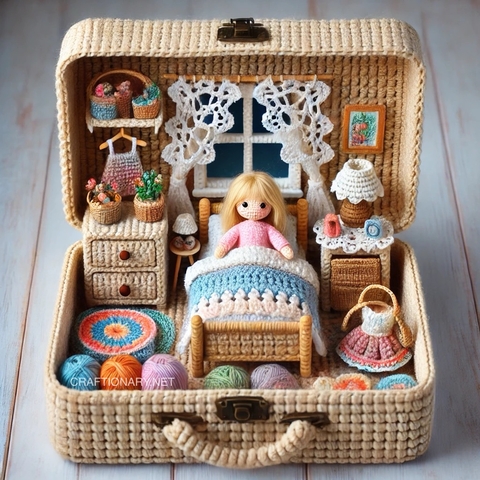
Free Crochet Dollhouse Pattern
Materials:
Before you start, gather the following supplies:
- Yarn (cotton or acrylic, various colors)
- Crochet hooks: 2.5 mm or 3 mm (sizes depending on yarn thickness)
- Stuffing (polyester fiberfill for furniture and soft walls)
- Plastic canvas or cardboard (for structural support)
- Tapestry needle (for weaving in ends)
- Scissors
- Fabric glue or stitch markers (optional)
- Small wooden beads or buttons (for drawer knobs and accessories)
- Air dry clay for forming decoration structures
Related: 30 Mini Clay Art Ideas for Tiny DIY Projects
Quick Pattern Instructions:
1. Create the Base Structure
The foundation of your crochet dollhouse is the walls and floor. You can make this in two ways:
1. Soft Structure
- Use single crochet (SC) stitches to create rectangular panels for the walls and floor.
- Sew or slip stitch the panels together to form a house shape.
- Use polyester stuffing inside to make it plush and soft.
2. Sturdy Structure
- Crochet rectangular panels just like in Option 1.
- Cut plastic canvas or cardboard to the same size as the panels or use an old box or suitcase.
- Crochet around the edges of the panels, inserting the stiff support inside before closing the seams.
3. Old Suitcase
The suitcase structure is covered in tight crochet stitches to give it a woven, textured look.
Base and Lid:
- Using beige yarn, chain the width of the suitcase.
- Work in single crochet (SC) rows until you have a rectangular piece large enough to wrap around the suitcase.
- Repeat for the inside lining.
- Attach the two layers by sewing or gluing them onto the plastic or cardboard frame.
Suitcase Sides: Work SC stitches in the round to form the edges.
Handle: For the handle, crochet a short SC strap, fold it, and sew it onto the front.
Suitcase Closure and Detailing: You can use a real metal clasp or crochet a small button loop closure to keep it shut.
2. Crochet the Roof
- Make a triangle or sloped rectangle using single or double crochet stitches.
- Attach it to the top of your dollhouse with slip stitches or sewing.
- For a removable roof, use buttons or Velcro to attach it.
3. Design the Interior
Now it’s time to decorate the inside of your crochet dollhouse!
1. Crochet the Walls and Flooring
- Use different crochet stitch patterns to mimic brick walls, wallpaper, or wooden floors.
- Striped or granny square patterns work great for rugs and carpets.
- Crochet flat rectangular panels in beige for the walls.
- The window frame is crocheted separately in white or blue and sewn onto the wall.
2. Add Crochet Furniture
Create mini crochet furniture such as:
- Chairs and tables: Small cylinders or rectangles stitched together.
- Beds and sofas: Crochet rectangles stuffed with fiberfill.
- Curtains and rugs: Use lace or shell stitches for a decorative touch.
- Nightstand: Crochet small cube panels and stitch them together to form drawers.
- Lamp: Crochet cylinder with a cone-shaped top. You may use clay for structure and cover with crochet.
- Wardrobe: Crochet a box-like wardrobe structure using Single Stitch (SC) panels.
- Clothes: Crochet tiny hangers and mini clothes (like the dress hanging inside
- Tiny baskets: Single Stitch (SC) in the round and can hold mini crochet flowers.
3. Windows and Doors
- Crochet small rectangles for windows and stitch them onto the walls.
- Use contrasting yarn colors to create a cute front door.
- The lace curtains are made with a delicate chain stitch and picot pattern.
4. Bed and Mattress
Bed Frame:
- Chain the desired width of the bed.
- Work in SC to create two long panels for the headboard and footboard.
- Crochet side rails and sew all parts together.
- You can insert a small wire frame inside for sturdiness.
Mattress and Bedding:
- Crochet a soft rectangle for the mattress in light blue or white.
- Stuff it lightly and close the edges.
- Crochet a lacy blanket using shell stitch for texture.
Pillows
- Crochet a small square in SC, stuff with fiberfill, and sew shut.
- You can add a scalloped edging or embroidery for extra charm.
4. Crochet the Doll
- Head and Body: Start with a magic ring and work Single Stitch (SC) in the round for the head. Use peach yarn for skin tone. Continue working downward for the body, adding arms and legs separately.
- Hair and Face: Attach strands of yarn for hair, styled as needed. Sew black bead eyes and embroider a smile.
- Clothes: Make a tiny dress using Single Stitch (SC) and shell stitches.
5. Add Finishing Touches
Now that the structure is complete, add charming details:
- Embroider flowers, vines, or bricks onto the walls.
- Attach mini crochet plants, pillows, or dolls inside.
- Add LED fairy lights inside for a magical glow.
- Make intricate clay miniatures to decorate your dollhouse.
Tips for Making a Crochet Dollhouse
- Use a sturdy yarn: Cotton yarn holds its shape well for structured designs.
- Stick to simple stitches: Single and double crochet stitches work best for firm panels.
- Make it modular: If gifting the dollhouse, consider making removable pieces so the recipient can rearrange furniture and rooms.
- Experiment with colors: Bright pastels or neutral shades can give your crochet dollhouse different aesthetics.
Frequently Asked Questions (FAQs)
1. Can you wash a crochet dollhouse?
If it’s made entirely of yarn, you can spot-clean it with a damp cloth. If it has a plastic or cardboard base, avoid getting it wet.
2. Can you make this without the metal clasp hardware?
Yes — a large crocheted button-and-loop closure or even a sewn-in snap will work fine as a substitute. The metal twist lock simply gives the most authentic suitcase look and the most satisfying click when it closes.
3. Why insert plastic canvas or cardboard into the base and furniture instead of just stuffing with fiberfill?
Fiberfill alone gives you a soft, rounded amigurumi look, which is lovely for toys but reads as melted for furniture with straight edges. A rigid insert is what gives you those crisp right angles on the dresser, table, and suitcase floor that make the room look architecturally believable rather than plush.
4. How long does this project realistically take?
Budget for roughly 15–25 hours total across the suitcase shell and all furniture pieces, spread over several sessions. I’d suggest treating the suitcase shell as one project session, then one furniture piece per sitting after that — trying to do it all in one go is where most crafters burn out on a build this size.
5. Can you substitute the yarn weight?
Yes, but keep the whole project in one weight category for consistent scale. Sizing up to worsted weight will give you a larger suitcase (more like a small handbag), which is a fun variation if you want the dollhouse to be extra roomy, but note that you’ll need proportionally more stuffing and slightly looser hooks throughout.
6. Do you need amigurumi experience before attempting this?
Comfort with basic amigurumi shaping (increases, decreases, working in continuous spiral rounds, invisible decrease) will make this much smoother. If you’ve never made an amigurumi piece before, I’d recommend a simpler single amigurumi project first to build muscle memory before tackling a multi-piece build like this one.
This crochet dollhouse with free pattern is a perfect handmade gift or keepsake that can be treasured for years. It’s a mix of crochet and crafting, giving a cozy and realistic miniature world inside a suitcase.
Written by: Hani Shabbir
You will also like:
70 DIY Dollhouse Ideas for all age enthusiasts
30 Mini Clay Art Ideas for Tiny DIY Projects
Please note: This is an inspirational project, with instructions and AI image generation to guide crafting original pieces for enthusiasts.